

Services
Personal Injury Attorneys in Montgomery, AL
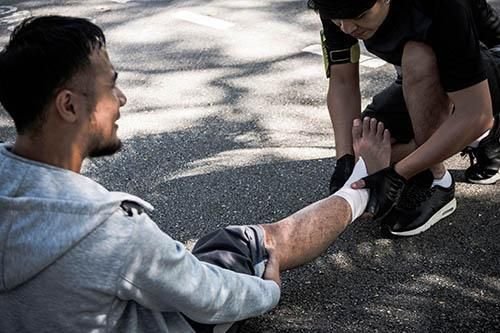
Slip and Fall Lawyers in Montgomery, Alabama
If you fell in a store, a restaurant or somewhere else open to the public and you were hurt, this page explains how Alabama treats that kind of claim. Barfoot & Schoettker handles slip and fall cases in Montgomery and Central Alabama.
These cases usually come down to something people do not expect: how long the hazard had been there before you reached it. A store is not responsible simply because someone fell in it, so what matters is whether the spill or the broken step sat there long enough that an employee should have found it. The sections below cover what to do first, what evidence to preserve, and the deadlines that apply.
What to do in the first hour after a fall
Report it to a manager before you leave, and ask for the incident report number. If you never ask, you may never learn one exists.
Photograph the substance close up, then step back and photograph the whole area. Two (2) things in that wider shot matter as much as the spill: whether a warning cone was anywhere in sight, and what the floor looked like around it — tracked through, dirty, dried at the edges. Those are evidence of time.
Get the names of the employees who came over, note the hour, and get checked out. Wrist, hip and closed-head injuries frequently declare themselves a day or two later, and an adjuster reads delay in treatment as evidence that nothing much happened.
Why the length of time decides the case
A customer who slipped on something in Alabama has three (3) ways to reach a jury: that the substance was on the floor "a sufficient length of time to impute constructive notice," that the store had actual notice of it, or that the store "was delinquent in not discovering and removing" it. Winn-Dixie Store No. 1501 v. Brown, 394 So. 2d 49 (Ala. Civ. App. 1981), quoted in Hale v. Kroger Ltd. Partnership (Ala. Civ. App. 2009).
Simply put, the store either knew or should have known, and "should have known" is measured on the clock. A storekeeper is charged with knowledge of a hazard that "has existed on the premises for such a length of time that a reasonably prudent storekeeper would have discovered and removed it." S.H. Kress & Co. v. Thompson, 103 So. 2d 171 (Ala. 1957).
The obvious objection is that nobody timed the spill. Alabama does not require anyone to: "Direct evidence of the length of time the offending substance has remained on the floor is not required." Cash v. Winn-Dixie Montgomery, Inc., 418 So. 2d 874 (Ala. 1982). A jury may infer it from the condition of the substance — "dirty, crumpled, or mashed." Maddox v. K-Mart Corp., 565 So. 2d 14 (Ala. 1990). Cart tracks through a puddle, produce brown at the edges, a footprint already in it: that is the proof.
What constructive notice looks like inside a file
That notice must be proven at all is general premises law, set out on our page on Alabama premises liability law and the duty a property owner owes you. What a fall case turns on is the record behind it. Most retailers of any size inspect on a schedule and write it down: sweep sheets, safety-sweep logs, hourly walk-through initials. That paperwork is the battlefield, and in the reported cases it has usually cut against the customer.
In Hale v. Kroger an inspection at 6:00 p.m. turned up nothing, the puddle was fresh, and the customer fell minutes later. No constructive notice. In Tucker v. Wal-Mart Stores, Inc. (Ala. Civ. App. 2012) the customer fell on grapes; two (2) hours of video showed nothing dropped, and the store documented a safety-sweep program. Again no notice. A customer "asserting delinquent inspection" must still prove the substance was there long enough that "an adequate inspection would have discovered it."
The useful questions are narrow. When was the last documented inspection, who signed for it, and does the log show a gap?
There is one route around the whole problem. Where the business or its employees created the condition — an employee mopping without a cone, a leaking cooler — notice need not be proven at all. Where a defendant or its employees "have affirmatively created the dangerous condition" the courts "presume notice." Wal-Mart Stores, Inc. v. Rolin (Ala. 2001). Accordingly, the first question in any of these cases is who put it there.
The evidence with the shortest life
Nearly every fact that decides a fall case sits in someone else's possession, on a timer. The surveillance recording is the worst of it. In almost every large store the footage is overwritten on a loop measured in days or weeks, and nobody preserves it because you fell. Someone has to ask, in writing, before the loop comes back around.
That request is not a formality. Under Smith v. Atkinson, 771 So. 2d 429 (Ala. 2000), a duty to preserve may be created by "a specific request," which "must be accompanied by an offer to pay the cost or otherwise bear the burden of preserving."
It is important to understand which remedy goes with which defendant. Smith is a separate lawsuit against a third party who lost evidence. Where the store itself is a party and failed to preserve what it had, the remedy is sanctions inside your case. Story v. RAJ Properties, Inc., 909 So. 2d 797 (Ala. 2005). The incident report, the sweep log, the maintenance ticket on the cooler: all of it is ordinary business paper purged on ordinary business schedules. The video does not wait two years.
Groceries, restaurants and retail
Grocery stores are the classic setting for a reason. The merchandise is wet, customers handle it themselves, and hundreds of people an hour walk the same tile: produce misters, ice machines, drink stations, freezer cases that sweat, entry mats on a rainy day in central Alabama. Restaurants add a kitchen; retail adds displays, pallets left in an aisle during a reset, and the lot and sidewalk on the approach, which the business often controls although it does not look like part of the store. What changes from one setting to the next is not the test. It is who keeps the records, and how often anyone inspects.
Alabama's contributory negligence rule in a fall case
Alabama is one of only four (4) states that never adopted comparative fault. If a jury finds the plaintiff was contributorily negligent, that is a complete bar to recovery on a simple negligence claim. Not a reduction. Sims v. Crates (Ala. 2000).
In a fall case the defense writes itself, and it is always the same sentence: you should have been watching where you were going. That is why an adjuster asks, several different ways, what you were looking at, and why an early recorded statement is dangerous.
However, winning on that defense before trial is harder than the sentence makes it sound. A defendant seeking summary judgment must show the plaintiff "put himself in danger's way" and "had a conscious appreciation of the danger at the moment the incident occurred." Daniels v. Wiley, LLC (Ala. 2020). Not that you could have seen it. That you did see it and understood what it was. Otherwise such questions are "normally questions for the jury." Terry v. Life Insurance Co. of Georgia, 551 So. 2d 385 (Ala. 1989).
Contributory negligence is also "not a legal defense" to a claim based on wantonness. Sims, id. Whether a hazard was so open and obvious that the owner owed no duty at all is a separate question under a different test, treated on the premises page above.
What affects a slip and fall case's value
No lawyer can tell you what a case is worth at a first meeting. The factors that move value are largely the ones that decide whether there is a case at all: how long the hazard sat, what the store's records show, and whether contributory negligence has anything to work with. After that the medical picture does the work — treatment, surgery, permanent restrictions, and lost earning capacity.
In Montgomery specifically
The rules above were written in Alabama grocery litigation, and the leading case on inferring how long a substance sat on a floor carries our city in its caption: Cash v. Winn-Dixie Montgomery, Inc.
A fall case filed in state court here goes to the Circuit Court for the Fifteenth Judicial Circuit, which serves Montgomery County. Where the store is a citizen of another state and more than $75,000 is in controversy, it can often be removed to federal court. 28 U.S.C. § 1332.
Frequently asked questions
What do I have to prove in an Alabama slip and fall case?
That the store had actual or constructive notice of the hazard, or was delinquent in not discovering and removing it. Winn-Dixie Store No. 1501 v. Brown, 394 So. 2d 49 (Ala. Civ. App. 1981).
Nobody saw the spill happen. Is my case over?
Not necessarily. "Direct evidence of the length of time the offending substance has remained on the floor is not required." Cash v. Winn-Dixie Montgomery, Inc., 418 So. 2d 874 (Ala. 1982). A jury may infer it from the condition of the substance, which is why photographs taken that day matter so much.
The store says it inspects every hour. Does that end my claim?
It makes the claim harder, and it is where these cases are frequently lost. In Hale v. Kroger an inspection minutes before the fall defeated constructive notice, and in Tucker v. Wal-Mart Stores, Inc. (Ala. Civ. App. 2012) a documented safety-sweep program did the same. Depending on the facts, gaps in the log can revive the question.
How do I get the store's surveillance video?
Someone has to ask in writing, and quickly, because it is usually overwritten on a loop measured in days or weeks. A duty to preserve can be created by "a specific request," which under Smith v. Atkinson, 771 So. 2d 429 (Ala. 2000) "must be accompanied by an offer to pay the cost."
What happens if the store erases the video?
Where the store is a party to the case, a court may impose sanctions. Story v. RAJ Properties, Inc., 909 So. 2d 797 (Ala. 2005). Smith v. Atkinson is the separate remedy against a third party who lost evidence.
Can I recover if I was not looking at the floor?
In many cases, yes. To win on contributory negligence as a matter of law a defendant must show the plaintiff "had a conscious appreciation of the danger at the moment the incident occurred." Daniels v. Wiley, LLC (Ala. 2020). Otherwise the question is normally one for the jury.
How long do I have to file a slip and fall claim in Alabama?
Generally two (2) years. Ala. Code § 6-2-38(l) requires that "[a]ll actions for any injury to the person or rights of another not arising from contract and not specifically enumerated in this section must be brought within two years." Falls on city or federal property run on much shorter deadlines — see our premises liability page.
What does it cost to talk to a lawyer about a fall?
Nothing. We handle these cases on a contingency fee, and there is never a fee for legal services unless we collect for you.
Talk to a Montgomery slip and fall lawyer
Barfoot & Schoettker is a small Montgomery firm whose practice focuses on personal injury. We handle fall cases against grocery chains, restaurants, retailers and property managers.
If you were hurt in a fall on someone else's property, contact us for a free case evaluation at (334) 834-3444. There is never a fee for legal services, unless we collect for you. The recording is on a loop; every day that passes is a day of it the store no longer has.